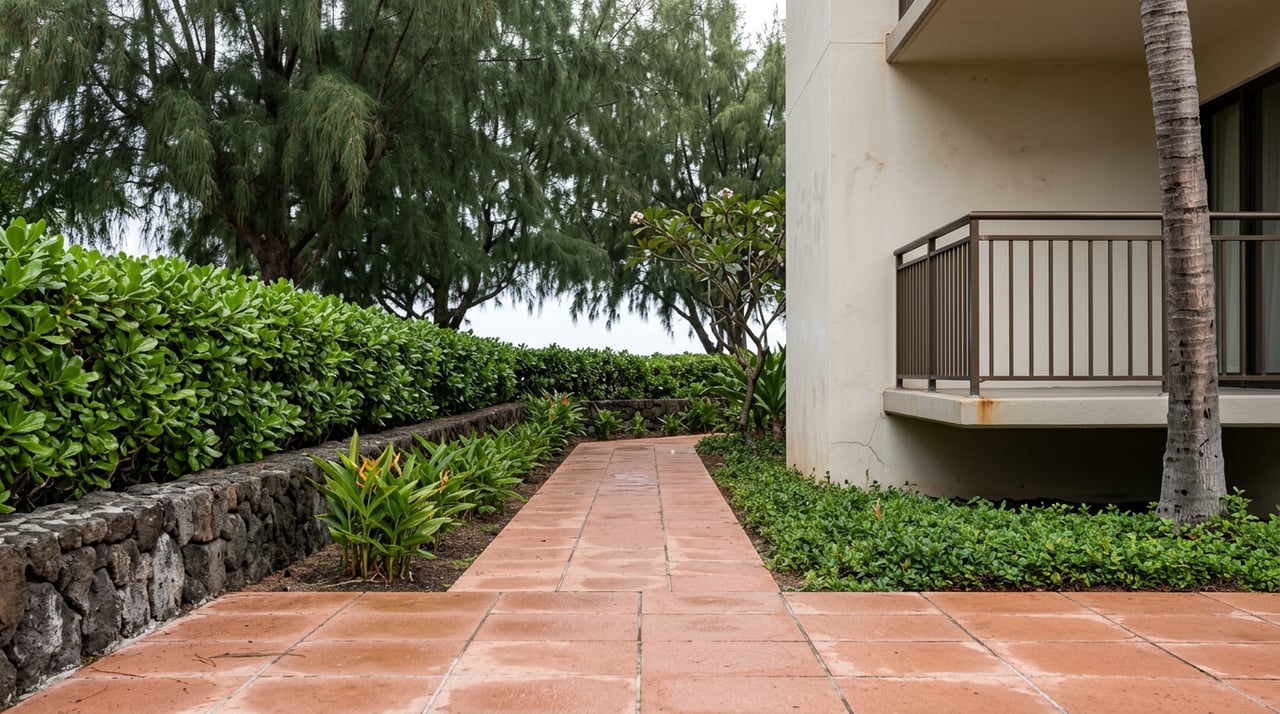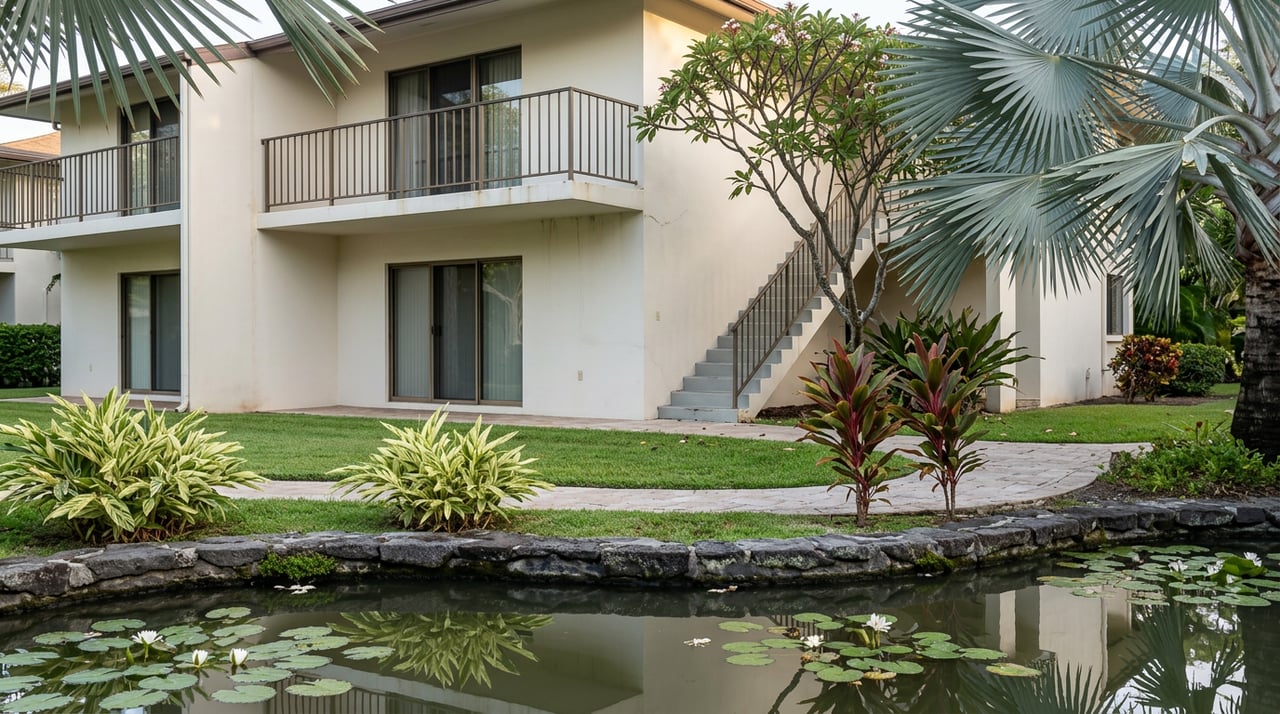
Picture two nearly identical one-bedroom units at Papakea Resort in Honokowai. Same square footage, same floor plan, same ocean glimpse through the palms. One lists for roughly half a million dollars. The other lists for nearly a million. For years, the answer to that gap has been simple: one is leasehold, the other is fee simple. Buyers learned to treat that discount as the whole story.
It isn't anymore.
Papakea just became one of only seven properties on all of Maui that the County Council is advancing toward hotel zoning on the strongest legal footing available, a status most of its own Honokowai and Kahana neighbors do not share. That single fact, not the leasehold discount everyone already knows to ask about, is now the number that should shape how a buyer reads price at Papakea.
The explanation everyone already knows
Papakea's land tenure split goes back to how West Maui resorts were originally built. In the 1960s and 1970s, local landowners leased land to developers rather than sell it outright, collecting rent instead of a lump sum. Decades later, many of those landowners offered to sell the underlying fee to unit owners. Some owners bought in and converted to fee simple. Others didn't, and their units stayed leasehold. That's why you can walk two doors down the same hallway at Papakea and find one owner who owns the dirt under their unit and one who pays ground rent to someone who does.
Recent comparable listings inside Papakea's own buildings show that gap running as wide as $450,000 to $500,000 between leasehold and fee-simple units with the same layout. It's a real number, and it matters. Leasehold buyers get in cheaper but take on ground rent that renegotiates on a schedule, financing that requires the lease term to outlast the mortgage, and a value curve that erodes as the lease clock runs down. Fee-simple buyers pay more up front and own the ground under them outright.
That's the trade every leasehold guide on the internet walks you through, and it's still true. It's also no longer the trade that determines Papakea's future.
The variable almost nobody is pricing in yet
Maui County passed Bill 9 in December 2025, and it did something structural: it closed the twenty-year-old loophole, known as the Minatoya List, that let roughly 7,000 apartment-zoned condo units across the county operate as short-term rentals. West Maui properties, including everything in Lahaina, Kaanapali, Honokowai, Kahana, and Kapalua, have until January 1, 2029 to stop renting short-term unless their building secures a new hotel-style zoning classification first.
That escape hatch exists. In June 2026, the council passed Bill 88, creating two new zoning categories, H-3 and H-4, that a building can apply to be rezoned into. Passing Bill 88 didn't rezone anyone automatically. It just opened a door. Whether a specific building walks through that door is being decided one numbered council resolution at a time, and the county is treating buildings very differently depending on why they think a building deserves to keep its short-term rental rights.
Two resolutions moved through committee together on July 6, 2026. Resolution 26-110 covers a broad category built around leasehold status, timeshare structure, or small parcel size, the argument being that these units are hard to convert into long-term local housing anyway. Resolution 26-111 covers a much narrower group of seven properties advanced on a different and stronger argument entirely: these buildings already function like hotels. They run front desks. They employ groundskeeping and maintenance staff. They operate as full-service visitor accommodations in every practical sense, regardless of what the zoning map calls them.
Papakea is one of those seven. So is Maui Eldorado in Kaanapali. Before Bill 9 even passed, Maui's own Planning Commission had flagged a handful of properties, including Papakea and Maui Eldorado, as places it thought deserved to be excluded from the phase-out altogether because their zoning and community plan designations already allowed transient rental use outright. Resolution 26-111 is the council formally picking up that recommendation.
That distinction is not cosmetic. A rationale built on "this building already operates like a hotel" is a more defensible legal position at the Planning Commission stage than a rationale built on "this unit happens to be leasehold." One is describing what the building already does. The other is asking for an exception because converting it to housing would be inconvenient.
What the resolutions actually say, side by side
| Resolution 26-110 | Resolution 26-111 | |
|---|---|---|
| Core rationale | Leasehold, timeshare, or small-parcel characteristics | Already operates like a hotel in practice |
| Kahana/Honokowai buildings named | Kahana Outrigger, Kahana Village | Papakea |
| Committee vote | Passed 6-2, July 6, 2026 | Passed 6-2, July 6, 2026 |
| Next step | Maui Planning Commission review, then full Council vote | Maui Planning Commission review, then full Council vote |
Both resolutions cleared committee the same day and both still need to clear the Planning Commission and a final council vote before any rezoning is real. Neither is finished business. But the reasoning behind them is not equal, and reasoning is what a planning commission and a court eventually weigh.
Papakea's neighbors did not land the same way
This is where the picture gets more useful for anyone shopping Kahana and Honokowai broadly, not just Papakea.
Kahana Outrigger, a sixteen-unit oceanfront leasehold complex in the heart of Kahana, and Kahana Village were both added to the broader Resolution 26-110 during the same July 2026 committee session. They're on the leasehold-and-timeshare track, the one with the weaker legal footing.
Kahana Reef didn't make either resolution in July. As of the council committee meeting on August 5, 2026, two competing council amendments were proposing to add Kahana Reef to a later resolution, 26-129, on a completely different basis: sea-level-rise exposure. That justification is still being argued over as of this writing, and Kahana Reef's zoning fate remains unsettled in a way Papakea's, provisionally, is not.
So within a few miles of coastline, three buildings sit in three different positions. Papakea has the county's own planning commission on record supporting its case. Kahana Outrigger and Kahana Village are riding a broader, less individually tailored rationale. Kahana Reef is still waiting to find out which resolution, if any, it lands in and on what grounds.
None of that shows up in a listing sheet. All of it shows up in how confidently you can underwrite a unit's rental income five years from now.
What this means before you write an offer
If you're comparing units in this area, the leasehold-versus-fee-simple question is still worth asking, but it's now only half the underwriting. The other half is which resolution, if any, names the specific building, and on what legal theory.
A short list worth working through with your agent before you get attached to a unit:
- Ask directly whether the building appears in Resolution 26-110, 26-111, or a later resolution like 26-129, and what rationale supports it.
- If the unit is leasehold, get the exact renegotiation and expiration dates from the master lease in writing, not from a listing description.
- Confirm the building's current zoning classification and Minatoya List status with the AOAO, since a proposed H-3 or H-4 designation is not the same as an approved one.
- If you're financing, verify with a Hawaii-based lender how they treat the specific lease term relative to your loan length, since practices differ by bank and the wrong assumption can stall a closing.
- Track the resolution's status directly, since the council has already amended these lists more than once and is expected to keep doing so.
The county's own rezoning tracker and public meeting records are the most current source for any of this, and they change often enough that a listing agent's summary from even a few weeks ago can be out of date.
A few straight answers
Does landing in Resolution 26-111 guarantee Papakea keeps its short-term rental rights? No. It still has to clear a Planning Commission review and a full council vote. What it has is a stronger starting argument than most of its neighbors, not a finished outcome.
Does this change the leasehold risk for the units at Papakea that are still leasehold? Not directly. Ground lease terms, renegotiation schedules, and financing constraints are a separate track from zoning. A leasehold unit in a building with strong rezoning prospects still carries every leasehold consideration it carried before.
If I'm planning to live in the unit full time rather than rent it, does any of this matter? Less, but not zero. Zoning status still affects resale value and who else can buy the unit from you later, and a leasehold's expiration timeline still affects your own financing and long-term equity regardless of how you use the property.
West Maui's zoning map is being redrawn building by building this year, and the buildings that come out ahead won't necessarily be the ones with the biggest historical price gap. They'll be the ones with the strongest paper trail. If you're weighing a specific unit in Kahana or Honokowai and want to know exactly where that building stands, Dee Garnes has spent two decades tracking these communities from the inside and can walk you through what a building's resolution status actually means for your offer. Schedule a private consultation before you write one.