"We already are in a situation where there's not enough water to meet the existing demand."
That's John Stufflebean, director of Maui County's Department of Water Supply, describing Upcountry Maui's water supply to reporters in October 2025. It's the line that shows up in almost every article about buying land in Kula, Pukalani, Makawao, or Haiku. The waitlist has been closed since 2013. Get on it if you can. Ask about a meter before you make an offer.
All of that is true, and none of it tells you what actually changed this year. On January 1, 2026, the county replaced the entire method it uses to decide how much water a property is allowed to use. If you're evaluating a parcel Upcountry right now, that date matters more than the size of the waitlist, because it determines which set of rules applies to what you want to build.
The Math Changed Before the Water Did
For decades, Maui County sized water demand by counting plumbing fixtures. A toilet was worth a certain number of points, a spigot another, and every meter size came with a fixture-point ceiling. Real estate agents who worked Upcountry regularly kept a mental spreadsheet: a 5/8-inch meter capped out around 31 points, a 1-inch meter around 128, and if you wanted to add a bathroom or a cottage past that ceiling, you were stuck unless you could buy additional fixture units.
That system is gone for new applications. Under Ordinance 5759, the county now calculates water demand using an Equivalent Single Dwelling, or ESD, a standard unit equal to 300 gallons per day. Instead of counting how many fixtures a house has, the county projects how much water the structure will actually use and sizes the connection to that number. The Department of Water Supply built a calculator and submittal checklist to help applicants run the new math themselves.
Here's what that swap actually means at the parcel level.
| Old system (fixture units) | New system (ESD), since Jan. 1, 2026 | |
|---|---|---|
| Unit of measure | Points assigned per fixture | Gallons per day, in units of 300 |
| Applies to | Permits and requests filed before Jan. 1, 2026 | Permits and requests filed on or after Jan. 1, 2026 |
| What it measures | How many sinks, toilets, and spigots you install | Projected actual daily water use of the structure |
| Where you'll run into it | Adding a bathroom or ADU to an older permit | Any new building permit or new water service request filed this year |
The county has been explicit that this doesn't touch existing accounts or applications already in the pipeline before the cutoff. But if you're buying land to build new, or buying a home with plans to add square footage, your contractor's water demand conversation now happens in gallons per day, not fixture counts. A parcel that a previous owner assumed was "maxed out" under the old point system may read differently once actual projected use, not plumbing inventory, is what gets measured. That's not a footnote. It's the number your architect and the county will actually argue about.
The Waitlist Behind the Waitlist
The 1,424 applicants recorded on the Upcountry priority list as of October 2025 aren't the whole story either. The more useful number is the one Stufflebean gave alongside it that same month: peak demand in the Upcountry system runs about 10.1 million gallons a day, against a maximum reliable supply of 9.7 million. The county has been short by roughly 4%, which is why the list hasn't moved much since it closed in 2013.
What's changed is that the county is now spending against that shortfall on a specific, named timeline rather than a vague promise. As of that October 2025 presentation, new filters at Upcountry treatment plants were targeted for completion in early 2026, at a cost of about $5 million, meant to raise reliable capacity from 9.7 to 11.2 million gallons a day. Two reservoirs near the Kamole Treatment Plant, sized at 72 million and 68 million gallons, were in the design stage at that time, with roughly $25 million in construction costs the county is trying to cover partly with federal funding. Longer term, the department is evaluating six additional wells in the Makawao aquifer area: Piiholo, Hokunui, Kealanoa, Kalialinui, Kula Kai, and Kula Ridge, according to the department's own presentation at the Hannibal Tavares Community Center in Pukalani.
The county's fiscal year 2027 budget, reviewed by the Maui County Council's Budget, Finance and Economic Development Committee in April 2026, sets a modest and specific target: approve 100 meters off the waitlist in the coming fiscal year. A hundred meters against 1,424 applicants tells you the pace of relief, and it's slower than the infrastructure spending headlines suggest.
Why Private Capital Can't Just Buy Its Way Around This
If you're the kind of buyer who assumes money solves scarcity, Upcountry has already tested that theory and rejected it. In early 2024, a Chicago-based firm called Free Market Ventures proposed buying 272 acres in Kula known as Kula Ridge Mauka, drilling one to four wells, and selling the water back to the county under a 30-year contract, with 21 homes built on the property as part of the deal. The county walked away from it after community members pushed back hard at meetings in Pukalani, and Maui County officially shelved the agreement in May 2024.
Part of what killed the deal was cost math that cuts both ways. Stufflebean told residents at the time that a single new county-built well runs roughly $30 million against an annual department budget he pegged at closer to $10 million, which is why the county has been reluctant to self-fund new wells and has instead leaned on leasing existing agricultural wells and private-public arrangements it can actually control. The proposed Kula Kai well, one of the six on the department's longer-term list, illustrates the same math: it would mean buying land from Haleakala Ranch and drilling at an estimated cost of about $20 million on its own. The takeaway for a buyer isn't that new supply is impossible. It's that new supply moves at the speed of county budgets and community consent, not at the speed of a check.
If the Parcel Has No Meter
Some Upcountry land simply doesn't have a meter and isn't going to get one soon. If that's the parcel you're circling, the two workarounds are a private well or a rainwater catchment system, and they land in a similar cost range for very different reasons.
A private well in Hawaii typically runs $15,000 to $40,000 once you include the Commission on Water Resource Management permit, drilling, and casing, though yield is never guaranteed until the bit hits water. That same guide flags something specific to this area: historic arsenic-based pesticide use in upcountry Maui means well water here should be tested for arsenic before you rely on it for drinking, not just for the standard coliform and nitrate panel.
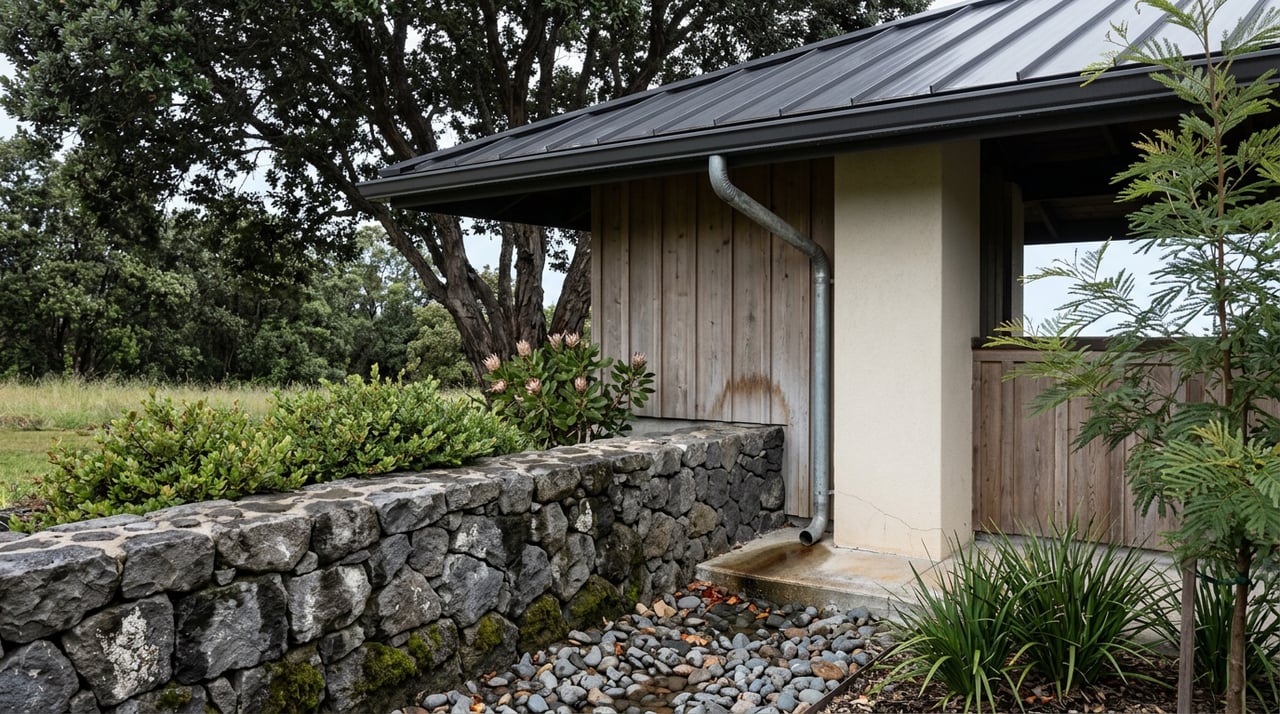
A turnkey rainwater catchment system, tank, pump, filtration chain, UV treatment, and installation, typically runs $12,000 to $40,000 depending on tank size and site access, with annual maintenance in the $800 to $1,800 range. It's worth remembering that the same drought that pushed the county into a Stage 3 shortage in October 2025 also means less rain landing on rooftops. A catchment tank isn't insulation from a dry year. It's a different relationship with the same weather.
For what it's worth, the drought that drove those restrictions has since broken. A Kona storm in March 2026 replenished reservoirs enough that the county lifted the Stage 1 shortage for Upcountry entirely, after a stretch that ran from Stage 1 in April 2025 through Stage 3 by October. That's the kind of swing that shapes how full the reservoirs feeding both the county system and your future catchment tank are likely to be in any given year.
Four Questions to Ask Before You Write an Offer
- Ask for the parcel's tax map key position, if any, on the current Upcountry Priority List, dated January 1, 2026 and published by the county's Engineering Division.
- Confirm whether the property already carries an active meter and its size. That single fact determines whether your future permit runs under the old fixture rules or the new ESD calculation.
- If you're building new or adding square footage, ask your contractor to run the ESD projection early in design, not after plans are drawn, since demand is now use-based rather than fixture-counted.
- If there's no meter and no near-term path to one, price a well or catchment system into your offer from the start rather than treating it as a contingency to sort out later.
A Few Straight Answers
Is the Upcountry water shortage still in effect? No. The county lifted the Stage 1 shortage for Upcountry in March 2026 after heavy rainfall from a Kona storm replenished reservoirs.
What exactly is an ESD? An Equivalent Single Dwelling, the new standard unit the county uses to calculate water demand, equal to 300 gallons per day.
Can I still apply to be added to the waitlist? No. The county stopped accepting new applications for the Upcountry priority list on January 1, 2013. If a parcel isn't already on the list, buying it doesn't add it.
Water access in Upcountry isn't a single yes-or-no question anymore. It's a set of dates, calculations, and named infrastructure projects that all move at their own pace, and the answer for any one parcel depends on which rules apply to it and when. If you're weighing a specific piece of Upcountry land and want help reading its meter status, its permit history, and what that means for your build plans, Dee Garnes works this market year-round and can walk through it with you before you write an offer.